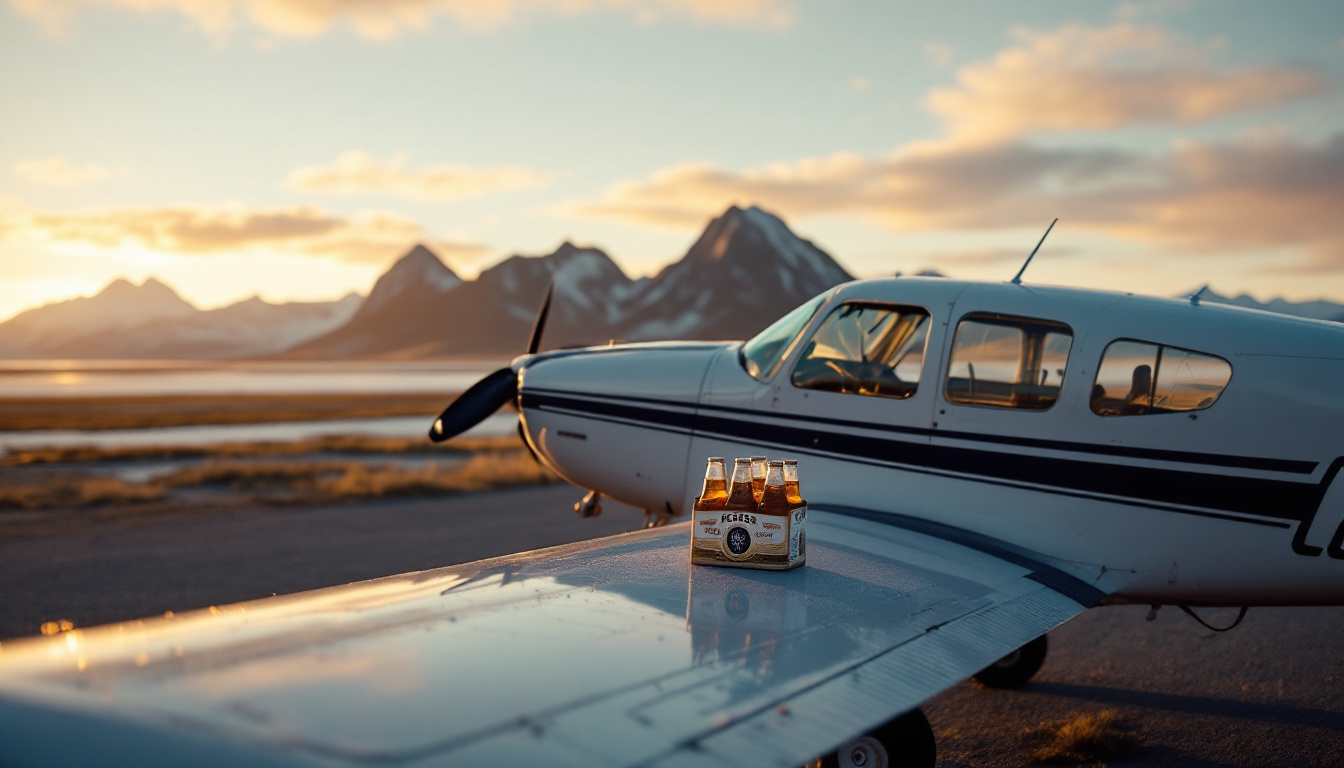
In April 2012, Kenneth Jouppi loaded up his 1969 Cessna on a Fairbanks runway to fly a passenger and some groceries to the village of Beaver, Alaska. Before he could take off, state troopers searched his plane and found a six-pack of Budweiser and Bud Light in his passenger's luggage. The passenger was bringing the beer to her husband.
The state of Alaska wants to keep Jouppi's $95,000 airplane. Over a six-pack.
Beaver is what's known as a "dry" village — alcohol possession and sale are banned within its limits. So the state charged Jouppi with a misdemeanor: knowingly transporting alcohol into a dry community. He was convicted, sentenced to 180 days in jail with 177 suspended, hit with a $3,000 fine — $1,500 of which was also suspended — and slapped with three years of probation. A misdemeanor conviction over beer he didn't even own, carried by a passenger he was hired to transport.
But the state wasn't satisfied with the criminal penalties. Alaska also moved to seize Jouppi's Cessna through criminal forfeiture — permanently confiscating a $95,000 aircraft because it was used in what amounted to a beer delivery.
The trial court initially blocked the forfeiture, ruling it wasn't allowed under state law. The Alaska Court of Appeals reversed that decision. Then the Alaska Supreme Court ruled unanimously that the forfeiture was constitutional "as a matter of law." No proportionality problem. No excessive fine. A $95,000 plane for a six-pack of Budweiser — perfectly reasonable, according to Juneau.
On Monday, the U.S. Supreme Court agreed to hear Jouppi's appeal in Jouppi v. Alaska, setting up what could be a landmark case on the Eighth Amendment's Excessive Fines Clause. The Institute for Justice, the public interest law firm representing Jouppi, argued in their petition that "few excessive fines cases will present the issue so sharply."
They're not wrong. Consider the math. The beer itself was worth maybe twelve dollars. The criminal fine was $1,500 after suspension. And the state wants to tack on a $95,000 asset seizure on top of that. That's not a fine proportional to the offense. That's a government looking at a misdemeanor and seeing a payday.
Alaska's defense is that alcohol abuse is a serious problem in rural communities, and that "airplanes are sometimes the only realistic means to commit the crime of alcohol importation." The question before the Court isn't whether dry-village laws are valid. It's whether the government can seize property worth thousands of times the value of the contraband involved.
This isn't a new fight for the Court. In 2019, the justices ruled unanimously in the Timbs case that the Excessive Fines Clause applies to the states. That decision involved a Land Rover LR2 valued at $42,000, seized after its owner sold $385 worth of heroin. The Court said the forfeiture was disproportionate. Now Jouppi's case asks the justices to sharpen that standard — because if a $42,000 SUV over heroin was excessive, a $95,000 airplane over a six-pack of Budweiser should be a layup.
As the Cato Institute has noted, "governments generate billions of dollars in revenue through civil and criminal asset forfeiture." The practice has drawn criticism from across the political spectrum precisely because it creates a financial incentive for law enforcement to seize first and justify later. Jouppi's case is the most absurd version of that incentive structure: an 82-year-old bush pilot who's been fighting this for over fourteen years.
"I'm in my 80s now, and I've been fighting this for over a decade because I see it as" protecting against government overreach, Jouppi said through his attorneys at the Institute for Justice.
Oral arguments are expected during the October 2026 term, with a decision likely by summer 2027. The Court will have to answer a simple question: can the state confiscate a man's livelihood over a misdemeanor beer run he didn't even pack for?
A six-pack of Budweiser costs about eight bucks at a Fairbanks gas station. The state of Alaska has spent fourteen years and untold taxpayer dollars trying to turn that into a $95,000 windfall. That's not law enforcement. That's a revenue model.